Internal bleaching and tooth bleaching in London

Treatment
90 minutes

Price
From £650

Team Experience
25+ years

Recovery Time
None

Google Rating
★★★★★ (4.9)
Examples of our work
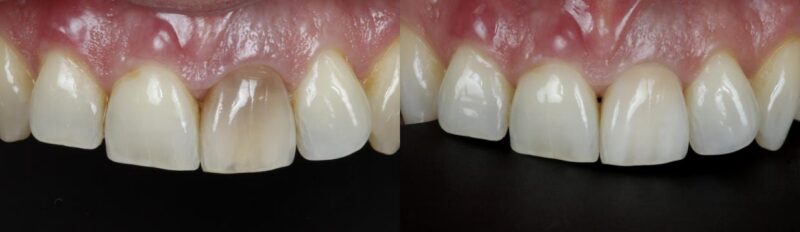
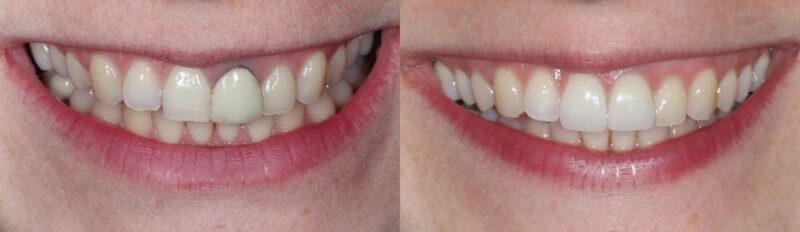
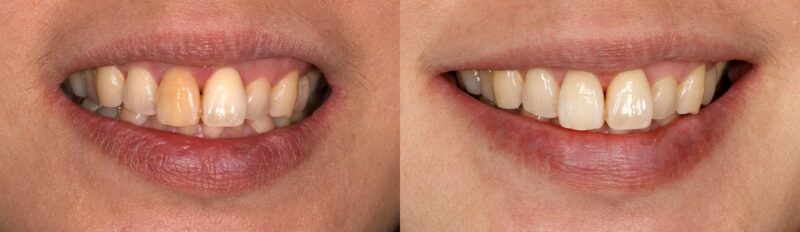
Internal bleaching is a safe and effective way to restore a tooth’s natural brightness. See here some remarkable examples of this procedure.
What is internal bleaching?
Internal bleaching, also known as non-vital tooth whitening, is a specialised tooth whitening treatment that lightens a discoloured tooth from the inside. Unlike regular office whitening or home teeth treatments that act on the outer surface of tooth enamel, internal bleaching works within the tooth structure itself.
A mild oxidising gel is placed inside the treated tooth, where it gradually removes internal intrinsic staining caused by a dead nerve or previous trauma. This controlled tooth bleaching procedure is safe, precise, and highly effective in restoring a uniform colour to your smile.
Why do teeth discolour?
Tooth discolouration can be extrinsic or intrinsic:
- Extrinsic staining occurs when pigments from food, drinks, or tobacco build up on the enamel surface. This can often be treated using professional teeth whitening, toothpastes, or strips and gels.
- Intrinsic staining occurs when discolouration originates within the tooth, often due to trauma, root canal therapy, or necrosis (tooth death). This type of staining typically requires internal bleaching to lift deeper pigments trapped beneath the tooth enamel.
In non-vital teeth, small blood particles and nerve remnants can penetrate microscopic canals in the dentine, darkening the tooth from the inside. Even after root canal treatment, up to 10% of patients find that their treated tooth remains discoloured — and this is where internal bleaching offers an ideal solution.
What are the options to treat a dark or discoloured tooth?
There are several ways to improve the colour and appearance of dark teeth:
- Internal bleaching (tooth bleaching) – lightens the tooth from the inside.
- Office whitening – brightens all visible teeth using professional hydrogen peroxide gel.
- Home teeth whitening – allows gradual brightening using custom trays and gels.
- Ceramic veneers, composite veneers, or crowns can restore both shape and colour if discolouration is severe.
Our dentists will recommend the least invasive option first. Internal bleaching often provides excellent results without the need for drilling, reshaping, or fitting veneers or crowns — helping to preserve your natural tooth.
Comparison: internal, home & office tooth whitening
| Treatment type | How it works | Best for | Results timeframe | Tooth preservation | Maintenance | Typical cost | Performed by |
|---|---|---|---|---|---|---|---|
| Internal bleaching (non-vital tooth whitening) | A gentle oxidising gel (often hydrogen or carbamide peroxide) is placed inside the tooth to remove intrinsic staining from trauma or root canal treatment. | Single dark or root-treated teeth; patients seeking to restore colour naturally. | 2–3 appointments over 1–2 weeks. | Excellent – no removal of tooth enamel. | Usually permanent; may require a rare top-up after several years. | From £650 per tooth. | Dentist (specialist or endodontist). |
| Office whitening (in-surgery whitening) | A high-strength whitening gel is applied to all visible teeth under professional supervision, sometimes activated by light. | Patients want quick, uniform whitening of all natural teeth. | 60–90 minutes for immediate results. | Non-invasive – no tooth reduction required. | Top-up every 6–12 months to maintain a whiter smile. | From £600 (full mouth). | Dentist / hygienist under GDC guidance. |
| Home teeth whitening | Custom trays are made and filled with a mild bleaching gel for daily wear over 1–2 weeks. | Gradual brightening and maintaining results after in-office treatment. | Visible change within 7–14 days. | Completely non-invasive; safe for tooth enamel. | Occasional reuse of trays with new gel. | From £400. | Dentist-supervised home kit. |
| Over-the-counter tooth whitening strips and gels | Low-strength peroxide or abrasive ingredients whiten surface stains from extrinsic staining. | Mild staining; patients seeking budget options. | Several weeks of daily use. | Gentle but limited effect on deeper stains. | Frequent re-application required; risk of uneven whitening. | £20–£80 (OTC). | Self-applied – no professional supervision. |
Choosing the right teeth-bleaching option for your smile
- Internal bleaching offers the best outcome for a single discoloured or root-treated tooth.
- Office whitening is ideal for rapid, even results across the full smile.
- Home whitening provides a convenient, gradual way to achieve and maintain brightness.
- Over-the-counter strips and gels can reduce surface staining but are less powerful than professional treatments.
Your dentist will always assess the cause of your staining — whether extrinsic or intrinsic — before recommending the safest, most effective way to achieve a lasting, whiter smile.
How does internal bleaching work?
The process of tooth bleaching in cosmetic dentistry from within follows a series of careful steps:
- Examination and preparation – The dentist examines the tooth and confirms suitability, sometimes using X-rays to check the root canal.
- Isolation – A dental rubber dam isolates the tooth, protecting surrounding tissues.
- Access creation – A small opening is made at the back of the tooth to reach the pulp chamber.
- Cleaning and sealing – The pulp chamber is cleaned and sealed above the root canal filling.
- Placement of bleaching agent – The dentist places a gentle oxidising agent such as hydrogen peroxide or carbamide peroxide inside the tooth.
- Temporary seal – The cavity is temporarily filled to secure the agent.
- Reassessment – After a few days to a week, the tooth shade is reviewed, and the process is repeated if needed.
- Final restoration – Once the desired whiteness is achieved, the dentist removes the whitening agent and permanently restores the tooth with a filling or partial crown.
This procedure is completely painless and minimally invasive.
What is needed for a successful internal bleaching treatment?
Before starting treatment, our specialists ensure:
- A successful root canal treatment with no inflammation or infection.
- Healthy gums and good oral health.
- No fractures or structural weaknesses in the tooth.
- A sound long-term prognosis.
If any issues are detected — such as infection or poor sealing of the root canal — these will be treated first by our endodontic specialist.
Meet your award-winning Internal Bleaching dentist and team…
With over 25 years of experience in complex tooth whitening and root canal treatments, and more than 10,000 procedures completed, our team is recognised as leaders in cosmetic and restorative dentistry, supported by internationally published research. Based in the heart of Marylebone, Central London, our state-of-the-art clinic delivers safe, predictable, and natural results, with our dentists and hygienists performing thousands of whitening treatments using internal, home, and in-clinic techniques.
Advantages of internal tooth bleaching
Conservative approach: No enamel removal or drilling required.
Restores confidence: Brightens a single dark tooth to match your other teeth.
Pain-free: Carried out under local anaesthesia or often requires none at all.
Long-lasting: Results can last several years with good hygiene.
Safe and effective: Minimal risk when performed by experienced dentists.
What happens after internal bleaching?
Most patients require two to three appointments to achieve the final result. Once the desired colour is reached, the cavity is sealed with a composite filling, veneer, or partial crown, depending on the tooth enamel condition.
The results are long-lasting, though occasional office whitening or home teeth treatments can help maintain brightness over time.

Looking for the best Internal Bleaching in London?
Having healthy, white teeth is an important factor for smiling with confidence. Discoloured teeth can affect your smile greatly. Whether internal whitening, in-office or home whitening or a combination of them, the dentists and dental hygienists in our clinic in London have a combined experience of several thousand whitenings performed to get you a first-class result.
Internal tooth whitening procedure is one of the least invasive ways to enhance your smile. The technique is quite sensitive, requiring precision and rigour from dentists who are experts in the field, but the results can be extraordinary. The procedure is completely painless.
Our commitment to quality, patient comfort, and advanced dental practices makes us the preferred choice for those seeking the best in oral health care.
Our clinic is conveniently located in the heart of Marylebone, Central London and is accessible by car, taxi, bus, Tube and on foot.
Internal Bleaching FAQs
Internal bleaching treats intrinsic staining caused by trauma or a dead tooth nerve, while external teeth whitening addresses extrinsic staining on the enamel surface. Internal bleaching is performed from inside the tooth, while home teeth and office whitening treatments act externally.
No. The procedure is painless and usually performed without anaesthetic. Some patients may feel temporary tooth sensitivity, but this is mild and short-lived. Our dentists ensure maximum comfort throughout your treatment.
Results typically last many years. The colour change is permanent, though some relapse can occur over time. Regular check-ups and good oral health practices — including professional cleanings — will help maintain your whiter teeth.
Yes. Combining internal bleaching for a single dark tooth with home teeth or office whitening can create a uniform, whiter smile. Your dentist will assess your tooth shade to design a balanced, natural result.
If the existing root canal is inadequate, our endodontist will first retreat the tooth to ensure it’s sealed and infection-free. Only then can tooth bleaching safely begin.
Alternatives include veneers, composite bonding, or crowns. However, these treatments require enamel removal. Internal bleaching is the least invasive way to lighten dark teeth while preserving your natural tooth structure.
Content updated
Written by: Prof Dr Christian Mehl
Medically reviewed by: Dr Raul Costa
New page content
Written by: Prof Dr Christian Mehl
Medically reviewed by: Dr Raul Costa
New page design
Written by: Prof Dr Christian Mehl
Medically reviewed by: Dr Raul Costa
Original content created
Written by: Prof Dr Christian Mehl
Medically reviewed by: Dr Raul Costa
Wimpole St Dental Clinic has strict sourcing guidelines and relies on peer-reviewed studies, academic research institutions, and medical associations. We avoid using tertiary references. You can learn more about how we ensure our content is accurate and current by reading our editorial policy.
- Frank AC, Kanzow P, Rödig T, Wiegand A. Comparison of the Bleaching Efficacy of Different Agents Used for Internal Bleaching: A Systematic Review and Meta-Analysis. J Endod. 2022 Feb;48(2):171-178. doi: 10.1016/j.joen.2021.10.011. Epub 2021 Nov 9. PMID: 34762968.
- Heboyan A, Avetisyan A, Karobari MI, Marya A, Khurshid Z, Rokaya D, Zafar MS, Fernandes GVO. Tooth root resorption: A review. Sci Prog. 2022 Jul-Sep;105(3):368504221109217. doi: 10.1177/00368504221109217. PMID: 35759366.
- Arshad M, Vaziri N, Habibzadeh S. Effect of Internal, Office, and Home Bleaching on Shear Bond Strength of Enamel to Porcelain Laminate Veneers. Int J Prosthodont. 2023 May-June;36(3):323-330. doi: 10.11607/ijp.7773. PMID: 36484656.
- Fernandez-Riera Y, Gutmann JL. Historical Reflections on the Use of Internal Bleaching to Manage Discolored Teeth. J Hist Dent. 2022 Summer/Fall;70(2):119-127. PMID: 35767301.